
'%3e%3cpath%20d='M15.1003%2043.5001C33.2091%2043.5001%2043.1166%2028.4935%2043.1166%2015.4838C43.1166%2015.062%2043.1072%2014.6307%2043.0884%2014.2088C45.0157%2012.815%2046.679%2011.0886%2048%209.11072C46.205%209.90932%2044.2993%2010.4309%2042.3478%2010.6576C44.4026%209.42594%2045.9411%207.49107%2046.6781%205.21166C44.7451%206.35724%2042.6312%207.16535%2040.4269%207.60134C38.9417%206.02324%2036.978%204.97835%2034.8394%204.62822C32.7008%204.27809%2030.5064%204.64222%2028.5955%205.66431C26.6846%206.68641%2025.1636%208.30953%2024.2677%2010.2827C23.3718%2012.256%2023.1509%2014.4694%2023.6391%2016.5807C19.725%2016.3843%2015.8959%2015.3675%2012.4%2013.5963C8.90405%2011.8251%205.81939%209.339%203.34594%206.29916C2.0888%208.46661%201.70411%2011.0314%202.27006%2013.4723C2.83601%2015.9132%204.31013%2018.047%206.39281%2019.4401C4.82926%2019.3905%203.29995%2018.9695%201.93125%2018.212V18.3338C1.92985%2020.6084%202.7162%2022.8133%204.15662%2024.5737C5.59704%2026.334%207.60265%2027.5412%209.8325%2027.9901C8.38411%2028.3864%206.86396%2028.4441%205.38969%2028.1588C6.01891%2030.115%207.24315%2031.8259%208.89154%2033.0528C10.5399%2034.2797%2012.5302%2034.9613%2014.5847%2035.0026C11.0968%2037.7423%206.78835%2039.2284%202.35313%2039.2213C1.56657%2039.2201%200.780798%2039.1719%200%2039.077C4.50571%2041.9676%209.74706%2043.5029%2015.1003%2043.5001Z'%20fill='%23F7F7F7'/%3e%3c/g%3e%3cdefs%3e%3cclipPath%20id='clip0'%3e%3crect%20width='48'%20height='48'%20fill='white'/%3e%3c/clipPath%3e%3c/defs%3e%3c/svg%3e)


If you are adding a product configurator to your website, you face a fundamental decision early on: build it from scratch with custom code, or use a no-code platform that handles the heavy lifting for you. This is not a trivial choice. It determines your launch timeline, your upfront investment, your ongoing maintenance burden, and ultimately how fast you can iterate on the customer experience. Both approaches have legitimate strengths, but for most businesses, one path is dramatically more efficient than the other.
This guide breaks down the real costs, timelines, and trade-offs so you can make an informed decision rather than an expensive guess.
The Case for Custom-Built Configurators
A custom-built configurator is exactly what it sounds like — your engineering team (or a contracted agency) writes the application from the ground up. The front end typically relies on WebGL libraries like Three.js or Babylon.js for 3D rendering, paired with a custom backend to handle pricing logic, order management, and asset pipelines.
The advantages are real. You get complete control over every pixel, interaction, and data flow. If your product has truly unique configuration logic — say, a structural engineering tool that must run finite element analysis in real time — custom code gives you the freedom to implement features that no off-the-shelf platform supports. You own the entire codebase, which means no vendor lock-in and no dependency on a third party's roadmap or pricing changes.
But those advantages come at a steep price. According to Keyhole Software's 2026 pricing benchmarks, custom software projects typically cost between $75,000 and $250,000, with complex enterprise systems exceeding $400,000. For a 3D product configurator specifically, the range is commonly $50,000 to $500,000 or more, depending on the number of product models, rendering fidelity, and integration requirements. Development timelines average 6 to 12 months for a production-ready system, and that is before you account for the ongoing cost of maintaining it. Annual maintenance typically runs 50 to 60 percent of the initial development cost, meaning a $200,000 build could require $100,000 or more per year just to keep running.
There is also the talent problem. Building a performant 3D configurator requires developers with specialized skills in WebGL, shader programming, 3D asset optimization, and real-time rendering — a combination that is expensive and difficult to hire for. If your core business is selling furniture or jewelry, not building 3D software, that expertise sits outside your competitive advantage.
The Case for No-Code Configurator Platforms
No-code and low-code platforms have moved far beyond simple form builders. The global low-code development market is projected to reach over $30 billion by 2026, according to Gartner forecasts. That growth is not accidental — it reflects a genuine shift in how businesses build software. Gartner predicts that 75 percent of all new enterprise applications will be built using low-code or no-code technologies by 2026, up from less than 25 percent in 2020.
For product configurators specifically, no-code platforms offer several compelling advantages:
- Speed to market: What takes 6 to 12 months in custom development can be deployed in days or weeks. Low-code tools can reduce development time by 50 to 90 percent compared to traditional coding.
- Lower cost: Instead of a six-figure upfront investment, you pay a predictable monthly subscription. Check out our pricing page to see how this compares to the custom-build numbers above.
- No specialized developers required: You do not need to hire WebGL engineers or 3D programmers. Product designers and merchandisers can build and manage configurators directly.
- Vendor-maintained infrastructure: The platform handles rendering performance, browser compatibility, mobile optimization, and security updates. Your team focuses on products, not infrastructure.
- Prebuilt templates: Platforms like Configurator.tech offer ready-made configurator templates across furniture, jewelry, cabinetry, and other industries, giving you a proven starting point.
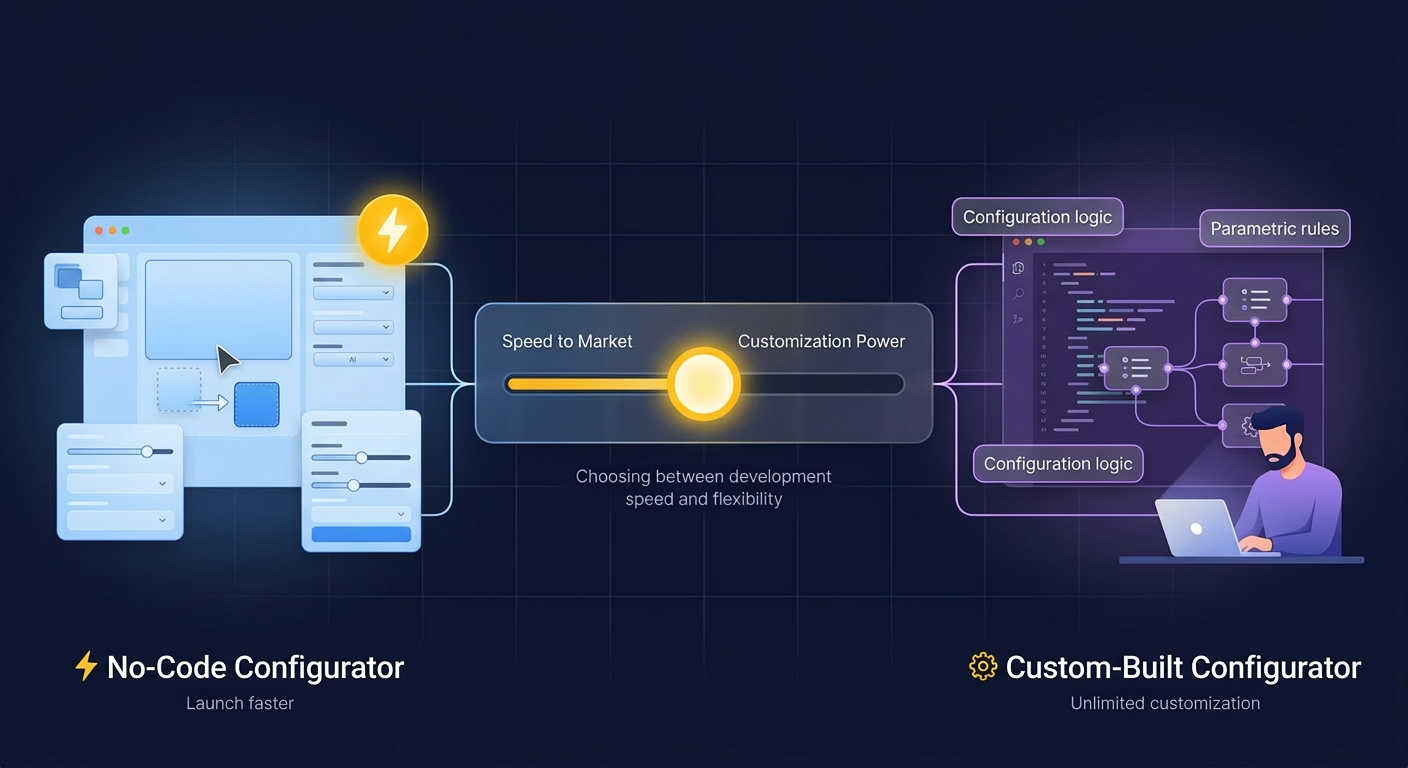
The trade-offs are real but manageable. No-code platforms impose some boundaries on customization — you work within the platform's feature set rather than writing arbitrary code. You also depend on the vendor for uptime, feature updates, and long-term viability. For most businesses, these trade-offs are well worth the 10x reduction in cost and time.
When Custom Makes Sense
Custom development is the right choice in a narrow set of scenarios. If you are a large enterprise with truly unique product logic that no existing platform can accommodate — for example, a manufacturer whose configurator must integrate with proprietary CAD/CAM systems and run real-time structural simulations — then custom code may be unavoidable. The same applies if your configurator is itself the product (a SaaS platform you are selling to others) rather than a tool supporting your e-commerce operations.
Companies like Threekit and ShapeDiver have built their businesses as custom-grade platforms, but even they illustrate the point: most of their customers use the platform rather than building from zero.
When No-Code Wins
For the vast majority of businesses — from DTC brands selling custom furniture to B2B manufacturers offering configurable industrial equipment — no-code platforms deliver everything needed without the overhead. You need your customers to select materials, adjust dimensions, see real-time 3D previews, get accurate pricing, and check out seamlessly. That workflow is well understood, and modern no-code configurator platforms handle it exceptionally well.
The adoption data confirms this trend: 87 percent of enterprise developers now use low-code platforms for at least some of their work, and 81 percent of companies regard low-code as an integral part of their strategic technology direction. The stigma of "no-code means limited" is fading fast as platforms grow more capable.
If you are selling products through Shopify, WooCommerce, or any other e-commerce platform, a no-code configurator gets you live in a fraction of the time, at a fraction of the cost, with a fraction of the risk.
The Middle Path: No-Code with Parametric Power
The most interesting development in this space is the emergence of platforms that combine no-code simplicity with the parametric flexibility typically reserved for custom-built solutions. This is exactly the approach behind BeeGraphy and Configurator.tech.
Rather than forcing you to choose between "drag-and-drop simple" and "write-everything-from-scratch powerful," BeeGraphy offers a node-based visual logic system. You define product parameters, constraints, pricing rules, and 3D model behavior by connecting nodes in a visual graph — no code required, but with the same expressive power you would get from writing custom logic. Need a table width to dynamically affect the number of support legs? Need material selection to change both the 3D texture and the price per square meter? Need to enforce manufacturing constraints like minimum wall thickness? The node-based system handles all of it without a single line of JavaScript or GLSL.
This matters because the typical criticism of no-code platforms — "they are fine for simple stuff, but we need more flexibility" — does not apply here. The parametric engine behind Configurator.tech is used by manufacturers building genuinely complex products, from modular kitchen systems to parametric architectural facades. The difference is that the complexity lives in the visual logic graph, not in hand-written code that requires specialized developers to maintain.
For businesses evaluating this decision, it is worth exploring what a modern no-code configurator can actually do before assuming custom development is necessary. Many teams discover that the "custom requirements" they assumed would force a ground-up build are already supported out of the box. Reach out to our team if you want to discuss whether your specific use case fits.
Making the Decision: A Practical Framework
To cut through the noise, ask yourself these five questions:
- Is your configurator the product, or a tool supporting your product? If the configurator itself is what you sell (a SaaS platform), custom makes sense. If it supports your e-commerce operations, no-code is almost always the better path.
- Do you have $100K+ and 6 to 12 months to invest before seeing results? Custom development demands both. No-code platforms get you live in weeks for a fraction of the cost.
- Do you have in-house 3D/WebGL engineering talent? If not, you will need to hire or contract it — and maintain that expertise indefinitely. No-code eliminates this dependency entirely.
- How fast do you need to iterate? With custom code, every product change requires developer involvement. With no-code, your product team can update configurators directly.
- What does your five-year total cost of ownership look like? Factor in maintenance at 50 to 60 percent of initial build cost annually. A $200,000 custom build costs $700,000 to $800,000 over five years. A no-code subscription is a fraction of that.
For most businesses, the math points clearly toward no-code — especially when platforms like Configurator.tech offer parametric depth that rivals custom solutions. The business case for adding a configurator is already compelling. The question is simply how you get there with the least cost, risk, and time.