
'%3e%3cpath%20d='M15.1003%2043.5001C33.2091%2043.5001%2043.1166%2028.4935%2043.1166%2015.4838C43.1166%2015.062%2043.1072%2014.6307%2043.0884%2014.2088C45.0157%2012.815%2046.679%2011.0886%2048%209.11072C46.205%209.90932%2044.2993%2010.4309%2042.3478%2010.6576C44.4026%209.42594%2045.9411%207.49107%2046.6781%205.21166C44.7451%206.35724%2042.6312%207.16535%2040.4269%207.60134C38.9417%206.02324%2036.978%204.97835%2034.8394%204.62822C32.7008%204.27809%2030.5064%204.64222%2028.5955%205.66431C26.6846%206.68641%2025.1636%208.30953%2024.2677%2010.2827C23.3718%2012.256%2023.1509%2014.4694%2023.6391%2016.5807C19.725%2016.3843%2015.8959%2015.3675%2012.4%2013.5963C8.90405%2011.8251%205.81939%209.339%203.34594%206.29916C2.0888%208.46661%201.70411%2011.0314%202.27006%2013.4723C2.83601%2015.9132%204.31013%2018.047%206.39281%2019.4401C4.82926%2019.3905%203.29995%2018.9695%201.93125%2018.212V18.3338C1.92985%2020.6084%202.7162%2022.8133%204.15662%2024.5737C5.59704%2026.334%207.60265%2027.5412%209.8325%2027.9901C8.38411%2028.3864%206.86396%2028.4441%205.38969%2028.1588C6.01891%2030.115%207.24315%2031.8259%208.89154%2033.0528C10.5399%2034.2797%2012.5302%2034.9613%2014.5847%2035.0026C11.0968%2037.7423%206.78835%2039.2284%202.35313%2039.2213C1.56657%2039.2201%200.780798%2039.1719%200%2039.077C4.50571%2041.9676%209.74706%2043.5029%2015.1003%2043.5001Z'%20fill='%23F7F7F7'/%3e%3c/g%3e%3cdefs%3e%3cclipPath%20id='clip0'%3e%3crect%20width='48'%20height='48'%20fill='white'/%3e%3c/clipPath%3e%3c/defs%3e%3c/svg%3e)


Staircases sit at the intersection of structural engineering, building code compliance, and interior design. Every staircase must safely carry load, fit within precise spatial constraints, and meet strict regulatory requirements for rise, run, headroom, and handrail height. At the same time, buyers increasingly expect their staircase to be a design centrepiece, not just a means of getting between floors. Product configurators are the technology that reconciles these demands, letting customers design visually striking custom staircases while the software enforces every engineering and code constraint behind the scenes.
This article explores the unique complexity of staircase configuration, the engineering challenges that make it different from other building products, and how parametric configurators are transforming the way staircases are designed, sold, and manufactured.
A Growing Market With Increasing Demand for Customisation
The global indoor staircases market was valued at approximately $6.5 billion in 2023 and is projected to reach $9.5 billion by 2032, growing at a compound annual rate of 4.2%. Within that, the spiral staircases segment alone is worth an estimated $2.1 billion and is forecast to reach $3.5 billion by 2032 at a 5.6% CAGR, driven by urbanisation and the need for space-efficient architectural solutions. The prefabricated interior staircase market adds another $1.55 billion, expected to grow to $2.04 billion by 2029 at a 4.74% CAGR. According to Harvard University's Joint Center for Housing Studies, spending on home renovations is projected to reach $400 billion annually, and staircases represent a significant share of high-value renovation projects.
Despite this scale, most staircase manufacturers still rely on manual quoting workflows, 2D drawings, and phone-based specification gathering. As buyers demand more complex geometries and premium materials, that analogue approach is becoming a bottleneck. For a broader introduction to how configurators address these challenges across industries, see our complete guide to product configurators.
Why Staircases Are Uniquely Difficult to Configure
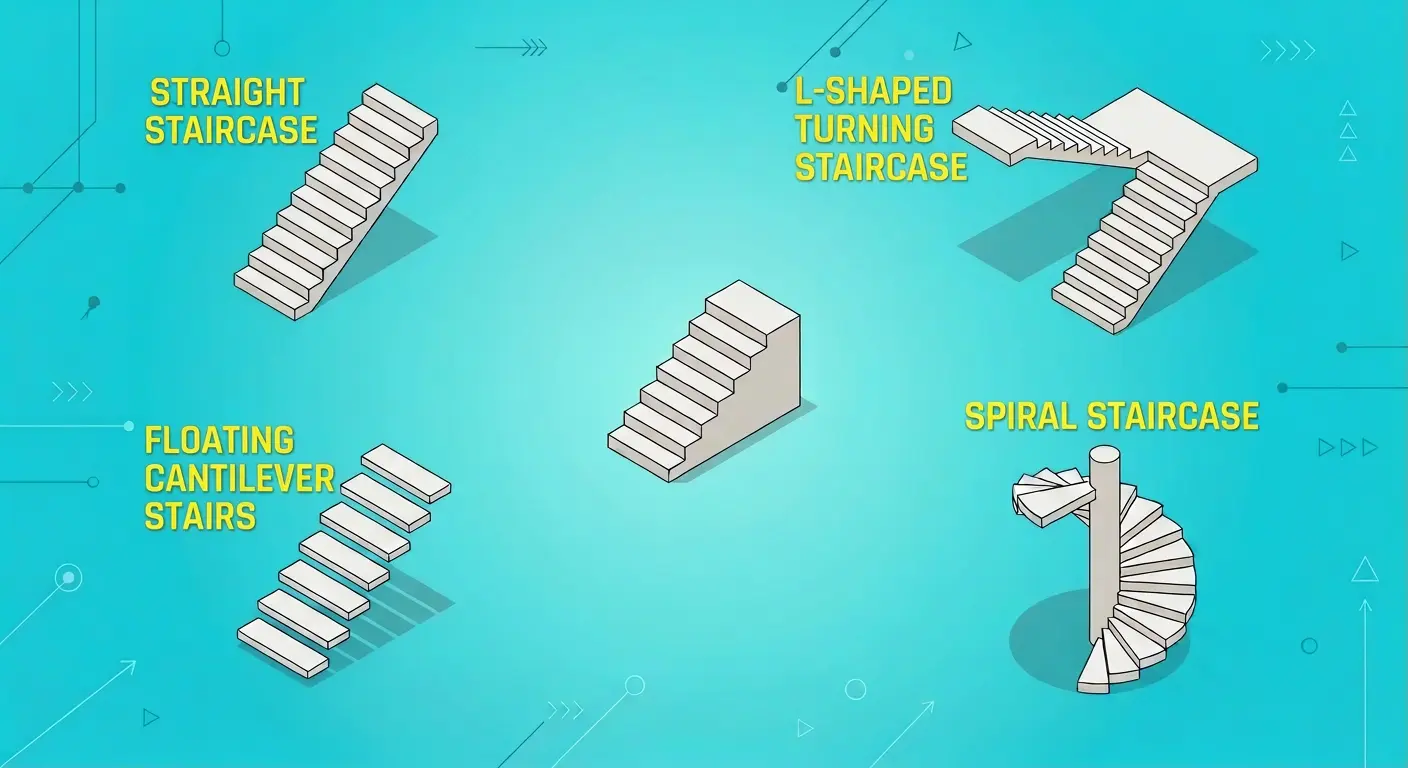
Unlike flat-pack furniture or rectangular windows, staircases are three-dimensional structures whose geometry changes fundamentally with each design choice. A straight flight, an L-shaped quarter-turn, a U-shaped half-turn, a spiral, and a helical staircase each follow completely different geometric rules. The configurator must handle all of them within a single parametric model.
The engineering constraints are non-negotiable. The International Residential Code (IRC) mandates a maximum riser height of 196 mm (7.75 inches) and a minimum tread depth of 254 mm (10 inches) for residential staircases. Headroom clearance must be at least 2,032 mm (6 feet 8 inches) measured vertically from the stair nosing. Handrail heights must fall between 864 mm and 965 mm (34 to 38 inches). Baluster spacing cannot exceed 100 mm (4 inches) to prevent a child from passing through. For spiral staircases, the IRC imposes a minimum clear width of 660 mm (26 inches) and a minimum tread depth of 190 mm (7.5 inches) measured 305 mm from the narrow edge.
These are not optional guidelines. Violating any of them means the staircase fails inspection. In traditional workflows, compliance verification happens after the design is complete, often after materials have been cut. Trimble research estimates that poor design contributes to $177 billion in construction rework annually in the United States. Staircase-specific rework is particularly expensive because each unit is custom-fabricated and cannot be returned to stock. The National Institute of Standards and Technology (NIST) estimates that manufacturing errors lead to scrap and rework costs of 5% to 30% of total production expenses.
How Configurators Solve the Engineering Challenge
A staircase configurator replaces the error-prone back-and-forth between customer, salesperson, and engineer with a single interactive environment where every design choice is validated in real time. The customer selects a staircase type, enters the floor-to-floor height and the available footprint, and the parametric engine calculates the optimal number of risers, tread dimensions, and turning geometry automatically. If a selection would violate building code, the system either adjusts the dependent parameters or flags the issue immediately, before any material is ordered or cut.
- Structural validation: The configurator calculates stringer lengths, load distribution, and connection requirements based on the selected material and span. For steel staircases, it factors in moment of inertia and deflection limits. For timber, it considers species-specific load ratings and grain orientation.
- Code compliance: Rise/run ratios, headroom clearance, handrail heights, and baluster spacing are enforced parametrically. The model will not allow the user to submit a configuration that fails code, eliminating the most common source of post-sale engineering revisions.
- 3D visualisation of complex geometry: Spiral and helical staircases involve compound curves that are nearly impossible to communicate through 2D drawings. A configurator renders the full three-dimensional form in real time, giving the customer an accurate preview of how the staircase will look and fit within the space.
- Material selection with structural implications: Switching from timber treads to glass changes the structural calculation, the connection detail, and the price. The configurator updates all three simultaneously, so the customer understands the trade-offs instantly.
- Real-time pricing: Material costs, fabrication complexity, finishing, and delivery are recalculated with every parameter change. For more on how dynamic pricing works in configurators, read our guide to real-time pricing in product configurators.
Data from staircase manufacturers adopting 3D configurators shows meaningful operational improvements. ThreeBuild reports that staircase companies implementing configurators have seen a 65% average increase in conversion rates, a 78% reduction in design revisions, and an 85% reduction in specification errors. These figures align with broader manufacturing data: industry research shows that approximately 30% of work done at construction sites is rework, and eliminating specification errors at the point of sale is the most effective way to prevent it.
Material Options and Their Configuration Complexity
Staircase materials span a wide spectrum, and each brings distinct engineering and aesthetic parameters into the configurator:
- Timber: Species selection (oak, walnut, ash, beech, pine) determines load capacity, finish options, and cost. The configurator adjusts tread thickness and stringer dimensions based on the wood's structural properties and applies species-specific finishing rules.
- Steel: Mild steel, stainless steel, and corten steel each have different structural ratings, corrosion properties, and welding requirements. Steel staircases often use laser-cut or CNC-plasma-cut components, so the configurator must generate DXF files with precise geometry for each unique configuration.
- Glass: Tempered or laminated glass treads and balustrades require specific thickness calculations based on span and load. The configurator factors in glass type, edge treatment, and fixing method to ensure structural adequacy and code compliance.
- Concrete: Cast-in-place or precast concrete staircases involve formwork geometry, reinforcement schedules, and curing requirements. Parametric models generate the formwork dimensions and rebar placement automatically.
- Hybrid combinations: Many premium staircases combine materials, such as a steel spine with timber treads and glass balustrades. The configurator must manage the interface details between dissimilar materials, including thermal expansion tolerances, fixing specifications, and finish compatibility.
This material complexity is what makes staircases fundamentally different from simpler configured products. Each material choice cascades through the entire engineering model, affecting structural calculations, connection details, production methods, and cost. A configurator that handles this correctly eliminates the manual engineering review that traditionally adds days or weeks to the quoting cycle. For a detailed look at how this connects to manufacturing, see our article on design-to-fabrication data pipelines.
From Configuration to Production: Automated Output
The real value of a staircase configurator extends beyond the customer-facing 3D experience. Underneath the visualisation sits a parametric model that encodes manufacturing logic. When a configuration is finalised, the system automatically generates production-ready output:
- DXF files for CNC: Stringer profiles, tread shapes, and connection plates are exported as vector files ready for laser cutting, plasma cutting, or CNC routing, with no manual redrawing required.
- Cut lists: Itemised lists of every timber member, steel section, and glass panel with precise dimensions, quantities, and material specifications.
- Bills of materials (BOMs): Complete parts lists including fixings, adhesives, brackets, and finishing materials, ready for procurement and inventory management.
- Assembly drawings: Step-by-step installation documentation generated from the 3D model, reducing on-site errors and installation time.
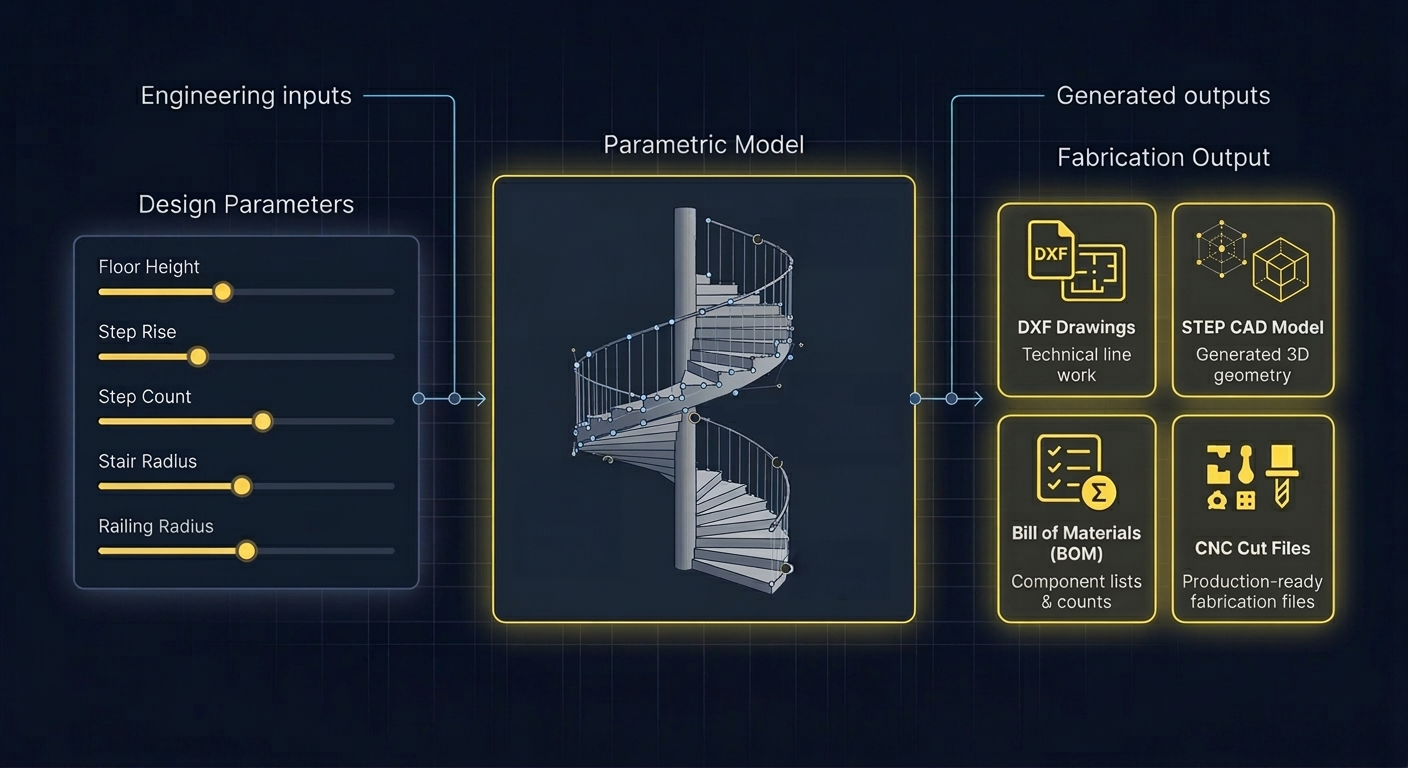
This design-to-fabrication pipeline eliminates the manual translation step where an engineer re-interprets a sales specification into shop drawings. The customer's design intent travels intact from browser to factory floor, and what was visualised is exactly what gets built. For staircase manufacturers processing hundreds of custom orders per month, this automation translates directly into shorter lead times and higher throughput.
How BeeGraphy's Parametric Engine Handles Staircase Geometry
Staircase geometry is among the most mathematically demanding in the building products space. A helical staircase, for example, follows a helix curve where the radius, pitch, and rotation angle are all interdependent. Change the floor-to-floor height, and the pitch changes. Change the diameter, and the tread geometry, handrail sweep, and stringer curvature all recalculate.
BeeGraphy's node-based parametric engine is purpose-built for this kind of complexity. Rather than hard-coding staircase shapes, the engine defines geometric relationships as a graph of interconnected nodes. Each node represents a parameter, a constraint, or a geometric operation. When a user changes the floor height, the change propagates through the graph, automatically updating every dependent dimension, structural calculation, and visual element. This approach means a single parametric model can generate straight, L-shaped, U-shaped, spiral, and helical variants without separate templates for each type.
Configurator.tech leverages this engine to provide staircase manufacturers with configurators that handle the full geometric and engineering complexity of their product lines. Our staircase industry solution includes pre-built parametric templates for the most common staircase types, each fully customisable to match your product range, materials, and pricing rules. The BeeGraphy marketplace offers additional ready-made staircase templates that can be deployed and adapted without 3D programming expertise.
Getting Started
Deploying a staircase configurator does not require building a parametric model from scratch. The fastest approach is to begin with an existing template:
- Select a template from the configurator library that matches your primary staircase type, whether straight flight, spiral, helical, or multi-flight.
- Customise the template with your material options, finish palettes, code compliance rules, and pricing structure using the visual node editor.
- Embed the configurator on your website, dealer portal, or showroom display with a single code snippet.
- Connect production by mapping configurator outputs (DXF, cut lists, BOMs) to your existing CNC workflow, ERP, or workshop management system.
The staircase market is growing, buyer expectations for digital design tools are rising, and the engineering complexity of custom staircases makes them ideally suited to parametric configuration. Manufacturers who offer an interactive design experience will close more sales, eliminate costly specification errors, and compress their quoting-to-production cycle from weeks to minutes.
Ready to bring your staircase products online? View pricing details or contact Configurator.tech to start building your first staircase configurator today.