
'%3e%3cpath%20d='M15.1003%2043.5001C33.2091%2043.5001%2043.1166%2028.4935%2043.1166%2015.4838C43.1166%2015.062%2043.1072%2014.6307%2043.0884%2014.2088C45.0157%2012.815%2046.679%2011.0886%2048%209.11072C46.205%209.90932%2044.2993%2010.4309%2042.3478%2010.6576C44.4026%209.42594%2045.9411%207.49107%2046.6781%205.21166C44.7451%206.35724%2042.6312%207.16535%2040.4269%207.60134C38.9417%206.02324%2036.978%204.97835%2034.8394%204.62822C32.7008%204.27809%2030.5064%204.64222%2028.5955%205.66431C26.6846%206.68641%2025.1636%208.30953%2024.2677%2010.2827C23.3718%2012.256%2023.1509%2014.4694%2023.6391%2016.5807C19.725%2016.3843%2015.8959%2015.3675%2012.4%2013.5963C8.90405%2011.8251%205.81939%209.339%203.34594%206.29916C2.0888%208.46661%201.70411%2011.0314%202.27006%2013.4723C2.83601%2015.9132%204.31013%2018.047%206.39281%2019.4401C4.82926%2019.3905%203.29995%2018.9695%201.93125%2018.212V18.3338C1.92985%2020.6084%202.7162%2022.8133%204.15662%2024.5737C5.59704%2026.334%207.60265%2027.5412%209.8325%2027.9901C8.38411%2028.3864%206.86396%2028.4441%205.38969%2028.1588C6.01891%2030.115%207.24315%2031.8259%208.89154%2033.0528C10.5399%2034.2797%2012.5302%2034.9613%2014.5847%2035.0026C11.0968%2037.7423%206.78835%2039.2284%202.35313%2039.2213C1.56657%2039.2201%200.780798%2039.1719%200%2039.077C4.50571%2041.9676%209.74706%2043.5029%2015.1003%2043.5001Z'%20fill='%23F7F7F7'/%3e%3c/g%3e%3cdefs%3e%3cclipPath%20id='clip0'%3e%3crect%20width='48'%20height='48'%20fill='white'/%3e%3c/clipPath%3e%3c/defs%3e%3c/svg%3e)


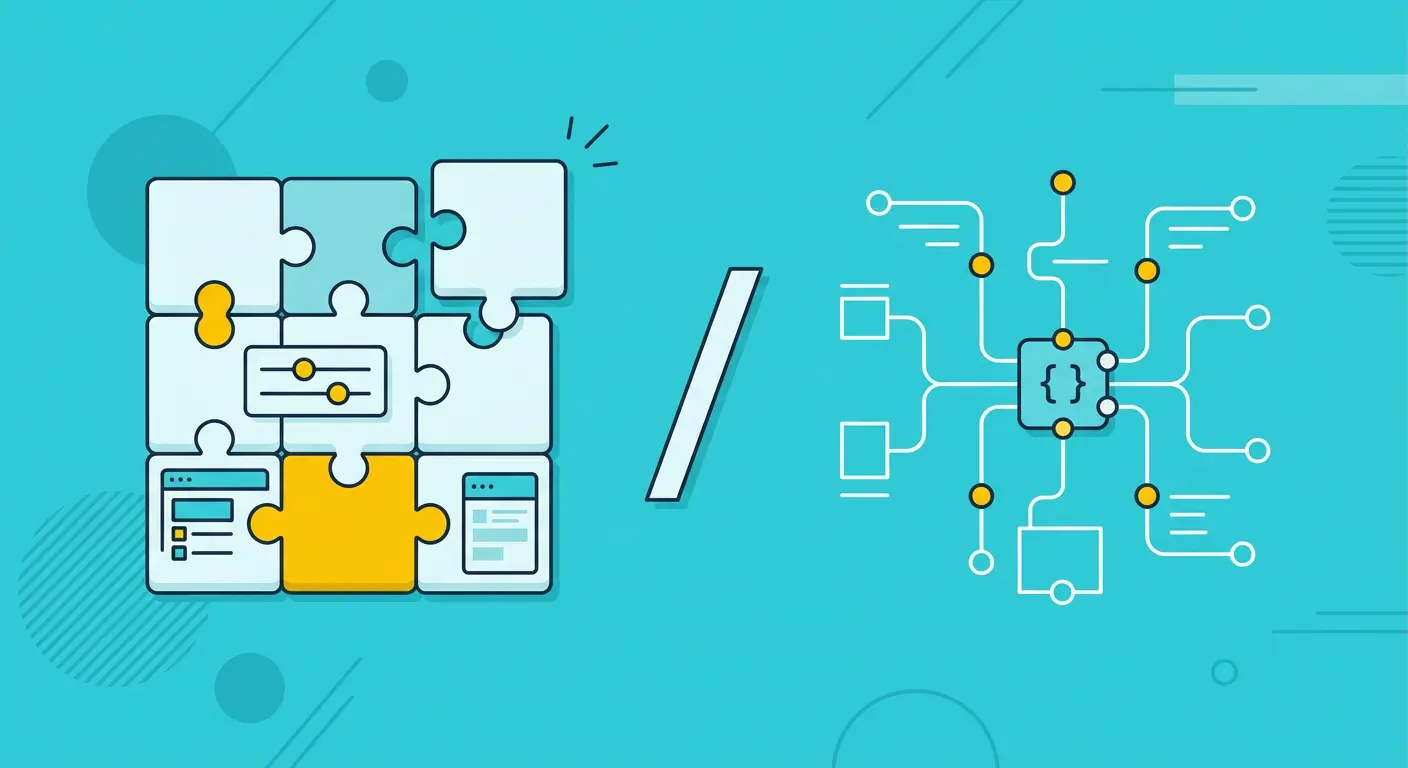
The e-commerce world is splitting in two. On one side, monolithic platforms bundle everything together — storefront, backend logic, database, and checkout — in a single tightly coupled system. On the other, headless commerce decouples the frontend presentation layer from the backend business logic, connecting them through APIs. For businesses selling customizable products, this architectural shift is not a theoretical debate. It is the difference between a configurator that works everywhere and one that is trapped inside a single platform's limitations.
This guide explains how headless commerce works, why it matters specifically for product configurators, and the concrete integration patterns that let you deploy interactive 3D configuration across any frontend — from Shopify Hydrogen to Next.js to custom React and Vue apps.
What Headless Commerce Actually Means
In a traditional monolithic e-commerce platform, the storefront (what customers see) and the backend (product catalog, inventory, pricing, checkout) are a single application. Shopify's standard Liquid theme, WooCommerce on WordPress, and Magento's default setup all follow this pattern. The frontend and backend are tightly coupled — changing how a product page looks means working within that platform's templating system and rendering pipeline.
Headless commerce removes that coupling. The backend exposes its data and functionality through APIs — typically REST or GraphQL — and the frontend is built independently using whatever technology the development team prefers. The "head" (the storefront UI) is detached from the "body" (the commerce engine). This means you can build your storefront in React, Vue, Svelte, or any framework, pull product data from a headless backend, and render the experience exactly the way you want.
The market has noticed. The global headless commerce market is valued at $1.74 billion in 2025 and is projected to reach $7.16 billion by 2032, growing at a 22.4% compound annual growth rate. According to Swell's 2025 headless commerce report, 73% of businesses now operate on headless architecture — a 14% increase from 2021 — and 92% of US brands have adopted some form of composable commerce.

Why Monolithic Platforms Limit Configurator Integration
If you have tried to embed an interactive 3D product configurator inside a traditional e-commerce platform, you have felt the friction. Monolithic platforms control the page rendering pipeline. Adding a complex JavaScript application — one that needs to load 3D assets, handle real-time user interactions, and communicate configuration data back to the cart — means fighting against the platform's assumptions about how pages should work.
On a standard Shopify Liquid theme, for example, you are constrained by the theme's section architecture and Liquid's server-side rendering model. You can embed an iframe or inject a JavaScript widget, and that works, but deeper integration — like dynamically updating the cart with configured product data, passing custom line item properties, or syncing configurator state with Shopify's variant system — requires workarounds. WooCommerce has similar constraints with its PHP-based templating and hook system. Every monolithic platform introduces its own set of limitations on what you can render, how you can interact with the cart, and how much control you have over the page lifecycle.
Headless commerce eliminates these constraints entirely. When the frontend is a custom application, you have full control over the DOM, the rendering pipeline, and the data flow. Embedding a configurator becomes a first-class integration rather than a hack bolted onto someone else's template.
The Embed-First Approach: Works on Any Frontend
The most practical way to deploy a product configurator across headless (and non-headless) frontends is the embed-first pattern. The configurator runs as a self-contained application — either inside an iframe or as an injected JavaScript widget — that can be dropped into any webpage regardless of the underlying technology stack. This is how Configurator.tech and BeeGraphy deliver their 3D configurators: the rendering happens in the cloud, the embed code is a single snippet, and it works identically whether the host page is built with React, Vue, plain HTML, or a Shopify theme.
The embed-first approach has a major advantage: zero dependency on the host application's framework or build system. You do not need to install npm packages, configure webpack plugins, or worry about version conflicts. The configurator is a standalone application that communicates with the host page through a well-defined message passing interface (postMessage API for iframes, or event callbacks for JavaScript widgets).
API-First Architecture for Deeper Integration
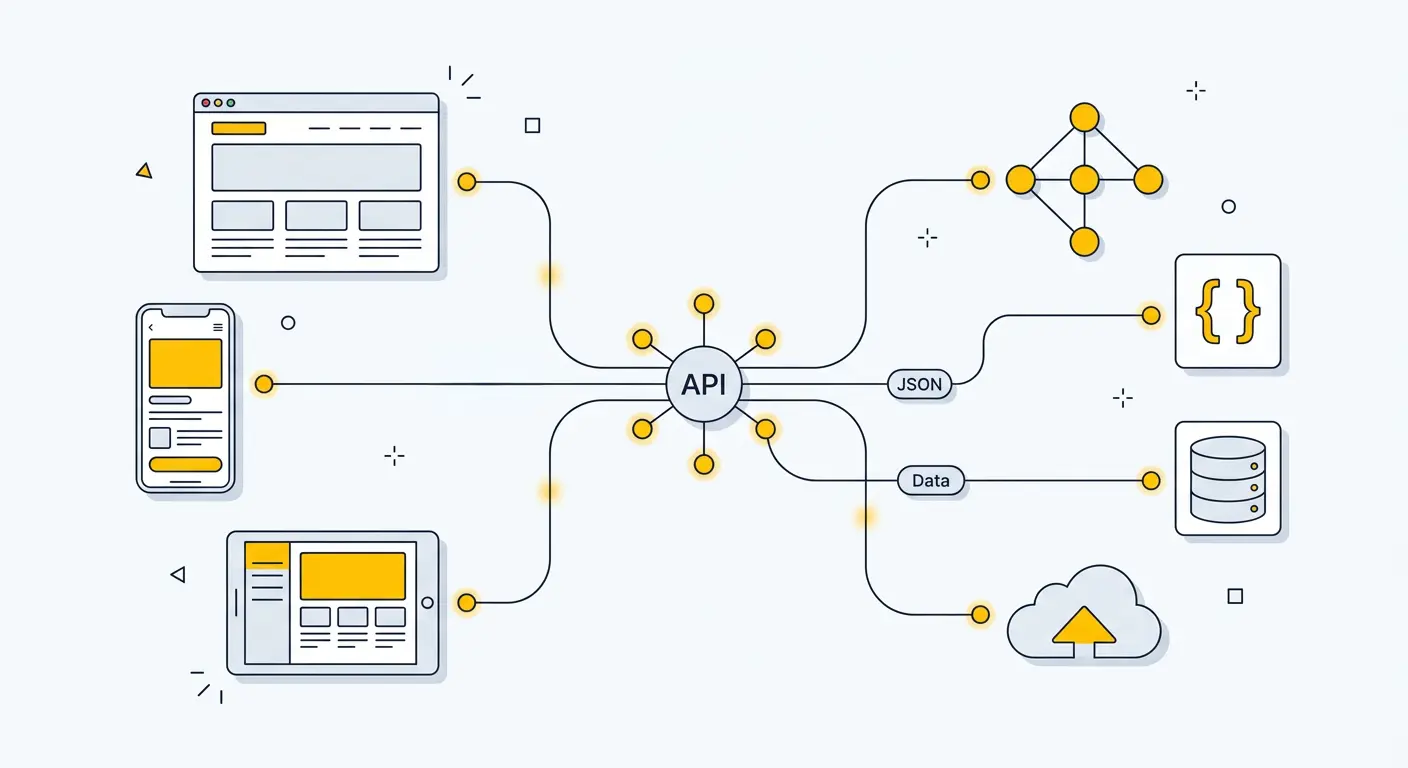
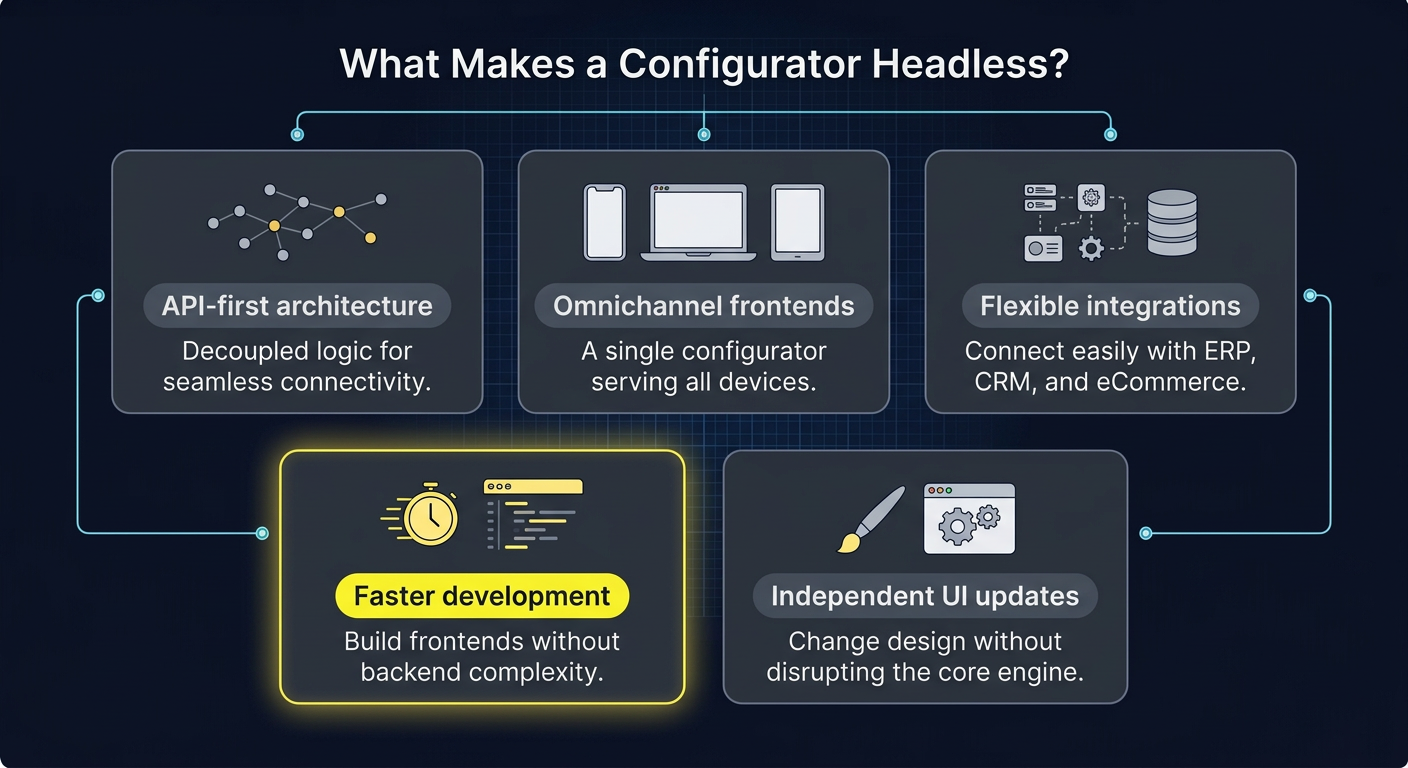
While embed-first gets you live quickly, headless commerce unlocks a deeper integration pattern: API-first architecture. In this model, the configurator exposes its own APIs (REST or GraphQL) that your headless frontend consumes directly. Instead of embedding an iframe, your React or Vue application renders the configurator natively, pulling 3D assets, product parameters, pricing rules, and constraint logic from the configurator's API. The configured product data then flows to your headless commerce backend — Shopify's Storefront API, BigCommerce's GraphQL API, or a custom backend — through another API call.
This pattern gives you complete control over the user experience. You can style the configurator controls to match your design system, implement custom transitions between configuration steps, and tightly integrate the configuration flow with your checkout process. The trade-off is more development work, but for brands investing in a differentiated headless storefront, this level of integration is often worth it.
The performance gains from headless architecture support this approach. Businesses implementing headless report a 20% decrease in website load times on average and a 42% increase in conversion rates. When your configurator loads as a native component rather than a third-party iframe, those performance benefits extend to the configuration experience itself.
Integration Patterns by Framework
The beauty of headless is that the integration pattern adapts to whatever frontend technology you are using. Here is how configurator integration works across the most common headless frameworks:
- Shopify Hydrogen: Shopify's React-based headless framework uses Remix under the hood. You can embed a configurator via iframe in any Hydrogen route component, or use Shopify's Storefront API alongside the configurator's API to build a fully native experience. Configured product data maps to Shopify's cart line item properties. If you are already on Shopify, Hydrogen is the natural path to headless.
- Next.js: The most popular React framework for headless commerce. Configurator embeds work in any Next.js page or component. For API-first integration, Next.js API routes can serve as middleware between the configurator backend and your commerce platform.
- Gatsby: Static site generation with dynamic client-side hydration. Configurators load client-side after the static page renders, which means fast initial page loads with interactive configuration available immediately after hydration.
- Custom React or Vue apps: Full flexibility. Mount the configurator embed in a component, or consume the configurator API directly and build a completely custom configuration UI. This is the approach for brands that want pixel-perfect control.
Regardless of the framework, the integration follows the same principle: the configurator is either embedded as a self-contained unit or consumed as an API service. The headless frontend orchestrates the experience.
Omnichannel: Same Configurator, Every Touchpoint
One of the most compelling advantages of headless commerce for configurators is omnichannel deployment. When your configurator is decoupled from any single storefront, the same configuration engine can power experiences across your website, a mobile app, an in-store kiosk, a sales rep's tablet, or a partner's embedded widget. The configurator does not care what renders it — it exposes the same APIs and embed interface regardless of the channel.
This is particularly powerful for B2B businesses where the sales process spans multiple touchpoints. A customer might start configuring a product on your website, continue the conversation with a sales rep who pulls up the same configuration on a tablet, and finalize the order through an EDI integration. Headless architecture makes this seamless because every channel talks to the same backend through the same APIs.
Businesses adopting headless architecture report 77% greater operational agility and a 50% reduction in time to launch new digital experiences. That agility means you can deploy your configurator on a new channel — say, an in-store kiosk or a partner marketplace — in days rather than months.
BeeGraphy's Approach: Cloud-Rendered 3D That Works Anywhere
The engine behind Configurator.tech takes a headless-native approach by design. BeeGraphy's configurators render 3D models in the cloud, which means the host device does not need powerful GPU hardware to display photorealistic product visualization. This is critical for headless deployments where you cannot control the end user's device — whether they are on a high-end desktop, a mid-range phone, or an in-store kiosk running basic hardware.
The embed-first delivery model means a single iframe snippet works identically on a Shopify Hydrogen storefront, a Next.js marketing site, a WooCommerce store, or a completely custom frontend. No framework-specific packages to install, no build configuration to manage. For teams that want deeper integration, the API layer supports custom frontend implementations where the React or Vue application consumes configurator data directly.
This dual approach — embed for speed, API for depth — aligns perfectly with how headless commerce projects evolve. Most teams start with an embed to validate the concept quickly, then migrate to API-first integration as the project matures and the business case for a fully custom experience is proven.
Getting Started with Headless Configurator Integration
If you are building or migrating to a headless commerce architecture, adding a product configurator does not need to be a separate engineering project. The prebuilt configurator templates on Configurator.tech give you a working configurator in minutes — embed it on your headless frontend and you have interactive 3D product configuration live immediately.
For teams evaluating the build-versus-buy decision, the headless model actually strengthens the case for using a platform like Configurator.tech rather than building from scratch. Building a cloud-rendered 3D configurator with its own API layer is a massive engineering undertaking. Using a purpose-built platform that already supports headless integration patterns lets your team focus on the storefront experience while the configurator infrastructure is handled for you.
The pricing page breaks down plans based on usage, and if you want to discuss your specific headless architecture and how a configurator fits in, reach out to the team for a technical walkthrough. Headless commerce is where e-commerce is going — and configurators that are built headless-native from the start are the ones that will keep up.